

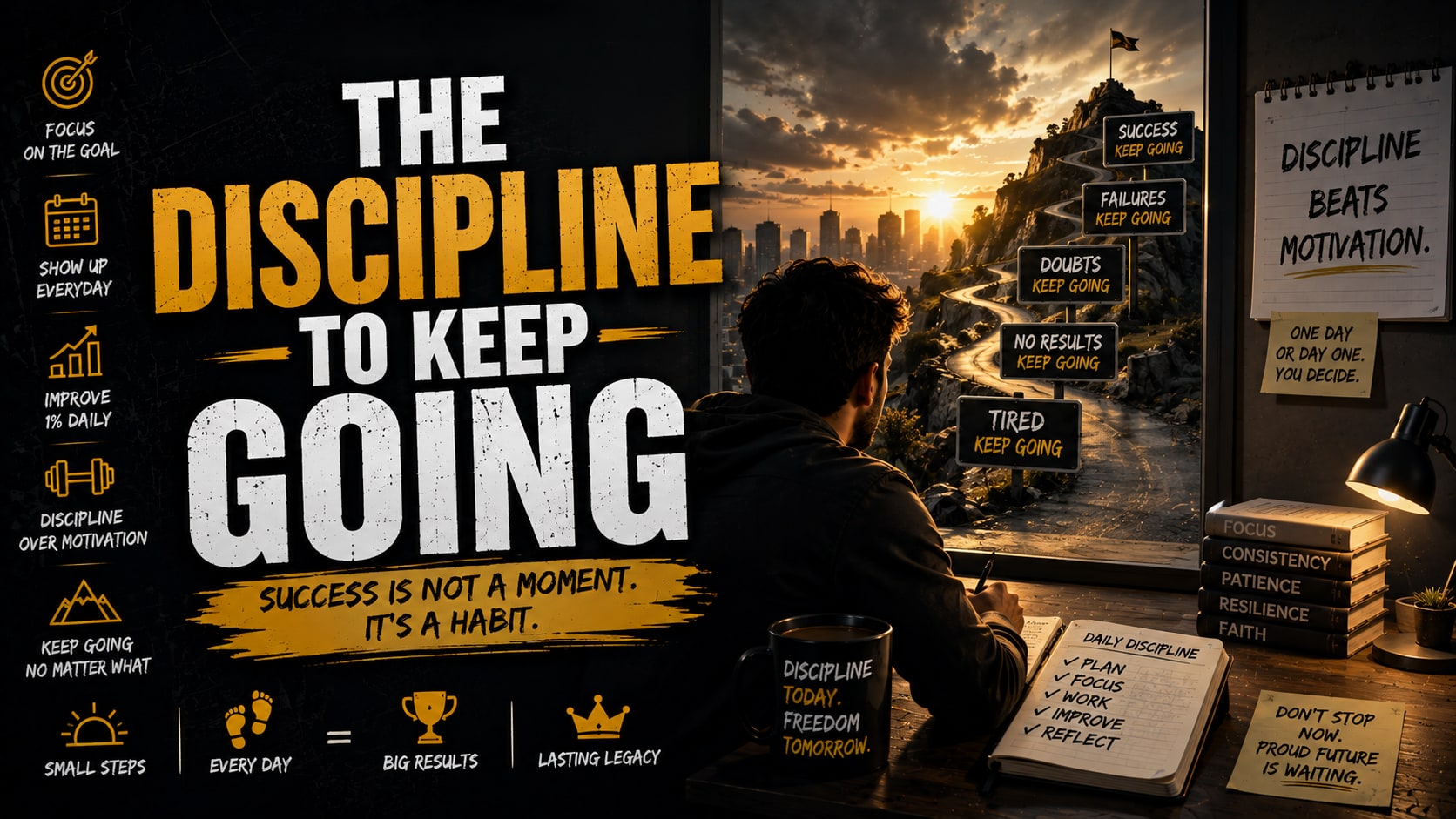
There is a moment in every journey when the excitement disappears. The idea that once made you feel alive becomes another responsibility. The business that once felt like a dream becomes invoices, meetings, customers, problems, salaries, deadlines and decisions.
In the beginning, everything feels exciting because everything is new.
You wake up with ideas.
You think about the future.
You imagine what the business could become.
You work late because you want to.
You don't need anyone to tell you to keep going.
You are driven by excitement. But excitement has a limitation. It doesn't last forever. And that is where many people stop.
Not because their dream was wrong.
Not because they weren't capable.
Not because the opportunity disappeared. They simply stopped showing up.
This is the difference between someone who starts something and someone who builds something.
Starting requires courage. Building requires consistency.
Anyone can work hard for a week.
Anyone can feel motivated for a month.
Anyone can make a powerful plan at the beginning of a new year. But what happens when nobody is watching?
What happens when the results are slow?
What happens when your last five attempts didn't work?
What happens when you are tired?
What happens when the business isn't growing as quickly as you expected?
What happens when you don't feel motivated anymore? That is when your real journey begins.
Because motivation asks: “Do I feel like doing this today?”
Discipline asks: “Does this still need to be done?” And those are two completely different questions. You cannot build a serious business based on how you feel every morning.
There will be days when you feel powerful.
There will be days when you feel exhausted.
There will be days when you believe you can conquer the world.
There will be days when you question whether you should continue at all.
Your emotions will change.
Your circumstances will change.
The market will change.
Your customers will change.
But your commitment to the vision has to remain strong enough to survive those changes. That doesn't mean blindly continuing in the same direction. Consistency doesn't mean repeating the same mistake every day. It means consistently moving toward the goal while being willing to change the path.
You may change your strategy.
You may change your product.
You may change your team.
You may change your market.
You may even change the business itself.
But you don't abandon the bigger purpose simply because the first version didn't work. That is the difference between persistence and stubbornness.
Persistence says: “I will find another way.”
Stubbornness says: “I will keep doing the same thing even though reality keeps telling me it doesn't work.” A smart entrepreneur knows the difference.
And perhaps the greatest misunderstanding about success is that people imagine it happening through one giant moment. They imagine one big investment.
One big customer.
One viral campaign.
One revolutionary idea.
One lucky opportunity.
But most successful businesses aren't built in one moment. They are built through thousands of small decisions.
One customer served properly.
One problem solved.
One improvement made.
One phone call.
One meeting.
One new skill learned.
One employee trained.
One process improved.
One mistake corrected.
One day of work followed by another. And another. And another.
From the outside, this can look boring. But inside those ordinary days, something extraordinary is happening. Compounding.
Your knowledge compounds.
Your relationships compound.
Your reputation compounds.
Your skills compound.
Your customer base compounds.
Your systems compound.
Your experience compounds.
And eventually, the small things you did consistently begin producing results that look much bigger than the effort that created them.
This is why you should never underestimate a small step repeated for a long time. A single workout doesn't transform your body. A single book doesn't transform your mind. One customer doesn't build a company. One day of discipline doesn't change your life. But repeated long enough, these small actions become something else. They become identity. And identity creates behavior. Eventually, you stop saying: “I am trying to build a business.” You simply become someone who builds. You stop asking: “Should I work today?”
You know that you work because that is who you are. That is when discipline becomes stronger than motivation. But consistency doesn't mean working twenty hours a day. This is another mistake people make. They believe that being dedicated means destroying themselves for the business. It doesn't.
If you work endlessly for six months and then burn out, you haven't built consistency. You have created an unsustainable sprint. Building a company is more like running a marathon. You have to understand your energy. Your health. Your time. Your priorities. Your people. Your finances.
You need to know when to push and when to recover. Because the goal isn't to work the hardest today. The goal is to still be strong enough to work tomorrow. And the day after that. And five years from now. And perhaps ten years from now. Longevity is a competitive advantage. There will always be someone willing to work harder for a short period. But very few people are willing to remain committed for years. That is where the difference is created. Imagine two entrepreneurs.
The first works intensely for three months, changes direction constantly, becomes frustrated when results don't come quickly and eventually quits. The second works steadily for five years. Not perfectly. Not without mistakes. Not without breaks. But consistently. Who do you think has the greater chance of building something meaningful? The answer isn't difficult. Time rewards those who remain in the game. And this is why you should stop looking only at today's results. Sometimes the work you are doing today is not supposed to pay you today. You are planting something. You are learning something. You are building something. You are preparing something.
A seed doesn't become a tree because you keep digging it up every morning to check whether it has grown. You plant it. You water it. You protect it. You give it sunlight. And then you allow time to do its work. Business needs the same patience. But patience does not mean sitting still. You still have to water the seed. You still have to protect it. You still have to remove the weeds. You still have to adapt to the weather. You still have to work. That is consistency.
There will also be periods when your progress becomes almost invisible. You work. You improve. You learn. But nothing seems to change. These are the periods that test entrepreneurs the most. Because when results are visible, discipline is easy. When results disappear, belief becomes difficult. You start wondering: “Is this worth it?” “Am I wasting my time?” “Maybe I should quit.” And sometimes quitting is the right decision.
But don't make that decision simply because the results are slow. Ask yourself whether the foundation is improving. Are you becoming better? Are customers becoming happier? Are your systems becoming stronger? Are you learning more? Are you getting closer to understanding the market? Are you becoming more disciplined? If the answer is yes, then perhaps progress is happening even if the numbers haven't caught up yet. Because not all growth is visible. Some growth happens underground. Like roots. And roots matter.
A tree doesn't become strong because of its branches alone. It becomes strong because of what nobody sees. Your business is the same. The systems nobody notices. The lessons nobody hears about. The difficult conversations. The financial discipline. The customer relationships. The skills you quietly develop. The mistakes you quietly correct. These are the roots. And eventually, the world sees the branches.
This is also why you shouldn't constantly compare your progress with someone else's. Someone may become successful in two years. Someone else may need ten. Someone may find the right market immediately. Someone else may spend years searching. Someone may have family wealth. Someone may start with nothing. Someone may have connections. Someone may have to build every relationship from zero.
You cannot compare two journeys simply by looking at their destinations. The only meaningful comparison is with the person you were yesterday. Are you smarter? Are you more disciplined? Are you more capable? Are you more patient? Are you making better decisions? If yes, you are moving forward. And sometimes moving forward means moving slowly. Slow is not the same as stuck.
There is nothing wrong with growing slowly if your foundation is becoming stronger. In fact, sometimes slow growth is healthier. You get time to understand your customers. You get time to train your team. You get time to improve your systems. You get time to understand your finances. You get time to make mistakes without those mistakes becoming catastrophic. You build strength before scale. And that matters because growth can expose weaknesses.
If you double your customers overnight but your operations cannot handle them, growth becomes a problem. If you double your team but have no leadership structure, growth becomes chaos. If revenue doubles but expenses grow even faster, growth becomes dangerous. So don't chase growth simply because growth looks impressive. Build the capacity to handle growth.
This is where consistency becomes more than simply working every day. It becomes consistently improving the business. Every month, something should become better. Your product. Your service. Your communication. Your marketing. Your finances. Your technology. Your people. Your systems. Even if the improvement is small. Because small improvements compound. One percent better doesn't look impressive today.
But repeated improvement can completely change the direction of a company over time. And the same applies to you. You don't need to become the greatest entrepreneur in the world tomorrow. You need to become slightly better than you were yesterday. Then tomorrow, do it again. And again. And again. Eventually, you won't recognize the person who started. That person was afraid. That person didn't know everything. That person made mistakes. That person didn't have the team. Didn't have the money. Didn't have the experience. But that person kept going. And because they kept going, they became someone different.
This is why dedication is not simply about working hard. Dedication is the ability to remain connected to your purpose when the excitement disappears.
It is waking up on an ordinary Tuesday and doing what needs to be done.
It is answering the customer when you would rather ignore the problem.
It is checking the numbers when you are afraid of what they might say.
It is improving the product when nobody is asking you to.
It is training your employee again because you know they can become better.
It is learning something new even when you think you already know enough.
It is making the difficult decision today because the easier decision will create a bigger problem tomorrow.
That is dedication. And sometimes dedication is knowing when to rest. Sometimes the most productive decision is to step away for a day. Clear your mind. Spend time with people you love. Sleep. Think. Come back stronger. A founder is not a machine. You cannot build a great company while destroying the person building it. Your business should become part of your life. It should not have to consume your entire life.
Because what is the point of building freedom if you become a prisoner of the thing you created?
The goal is not simply to build a bigger business. It is to build a business that creates a better life. For you. For your team. For your customers. For the people connected to it. And eventually, if you remain consistent long enough, something changes. The business begins to move without you pushing every second.
The team understands the vision. The customers trust the brand. The systems work. The revenue becomes more predictable. The reputation becomes stronger. The business begins to stand on its own. And you realize that the small decisions you made years ago were quietly creating this moment.
That's the beauty of consistency. It doesn't always announce itself. It doesn't always look impressive. It simply keeps working. Day after day. Month after month. Year after year. Until one day, people call you successful. But you know something they don't. There was no single day when you became successful. There were thousands of days when you simply refused to stop becoming better. That is the story nobody sees.
People see the company. They see the office. They see the team. They see the revenue. They see the success. But they don't see the ordinary mornings. The failed ideas. The rejected proposals. The difficult decisions. The sacrifices. The boring work. The repetition. The years. And perhaps that's why success sometimes looks like luck from the outside. People see the result.
They don't see the consistency that created it. So if your business is small today, don't be ashamed of it.
If your numbers are small today, don't let them define your potential.
If your team is small, build it carefully.
If your audience is small, serve them deeply.
If your first product is imperfect, improve it.
If your growth is slow, strengthen the foundation.
Keep moving. Keep learning. Keep building.
Because a small business that improves every year can become a completely different business five years from now. And five years after that, it may become something you never imagined when you started. But none of that happens if you keep restarting. You have to give something enough time to grow. You have to stay long enough to become good. You have to remain in the game long enough for your experience to become an advantage. And that is why consistency is so powerful.
It turns effort into skill. Skill into value. Value into trust. Trust into customers. Customers into revenue. Revenue into resources. Resources into growth. Growth into opportunity. And eventually, opportunity into something much bigger than where you started. A legacy. Not because you had one perfect idea. But because you kept improving an imperfect idea for long enough.
So when tomorrow comes, don't ask yourself whether you feel motivated. Ask yourself something deeper: “What is the next thing I need to do?” Then do it. Not perfectly. Not dramatically. Just consistently. Because the future you imagine is not built in one extraordinary day. It is built in ordinary days that you refused to waste. And perhaps, at the end of this journey, you will discover that success was never hiding in one big opportunity.
It was hiding inside the discipline to keep taking the next step.
“Great businesses are rarely built by the person who works the hardest for one day; they are built by the person who keeps showing up long after everyone else has stopped.”
K.S.Lakhotia