

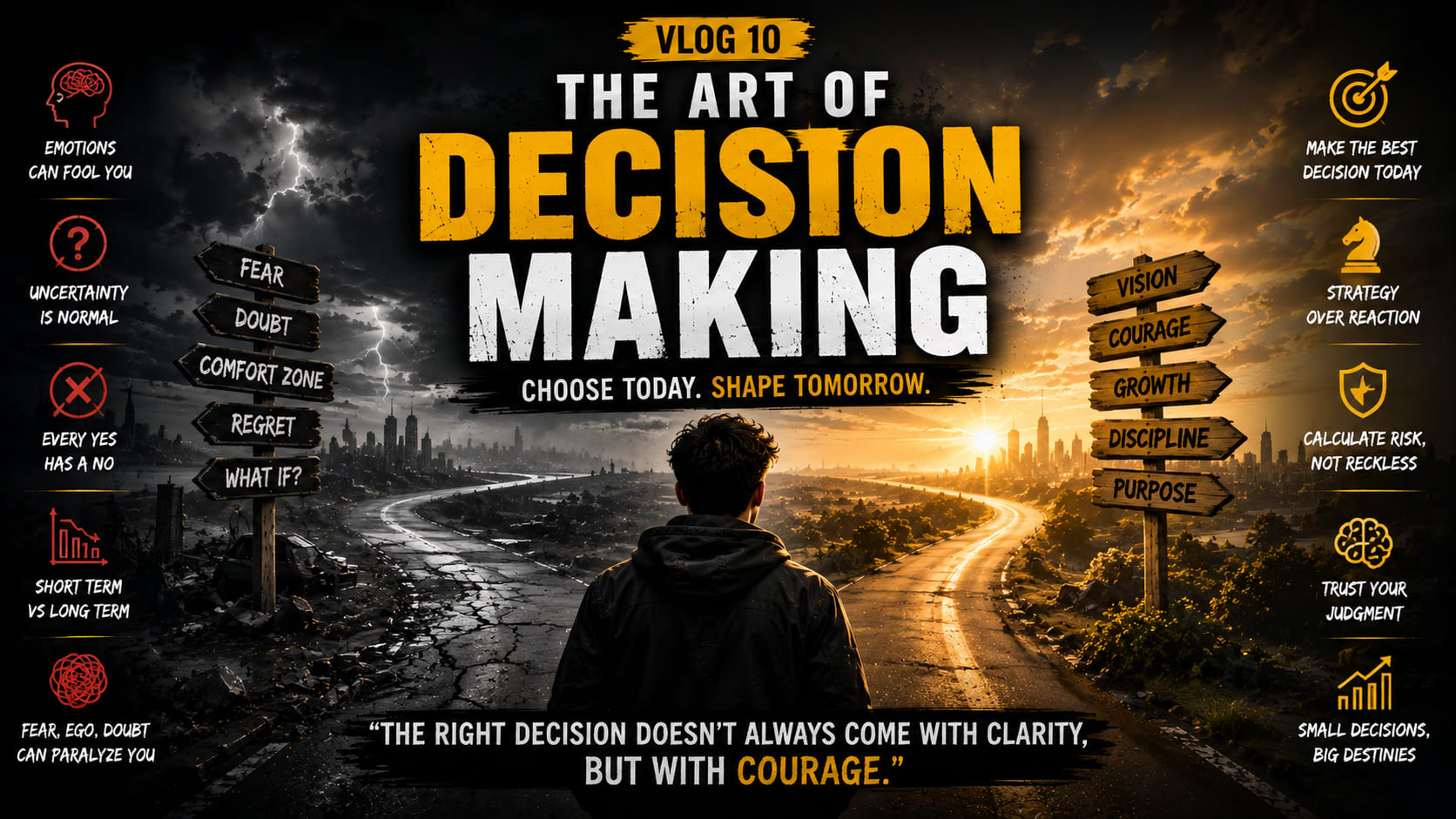
There comes a point in every entrepreneur's journey when nobody can tell you what to do.
There is no perfect answer.
No guaranteed outcome.
No book that can tell you exactly what will happen next.
There is only a situation in front of you, the information you have, the information you don't have, and a decision that only you can make.
This is where entrepreneurship becomes more than business.
It becomes a test of judgment.
Because in the beginning, you are mostly learning how to start.
Then you learn how to sell.
You learn how to serve customers.
You learn how to survive failure.
You learn how to build a team.
You learn how to stay consistent. But eventually, you reach a stage where your biggest responsibility is no longer doing the work. It is deciding what work should be done. And that is a completely different skill. Every business is a collection of decisions.
What should we build?
Who should we serve?
How much should we charge?
Who should we hire?
Who should we trust?
What should we invest in?
What should we stop?
Should we expand?
Should we wait?
Should we take the opportunity?
Should we walk away?
Should we listen to the market?
Or should we believe in the vision even when the market doesn't understand it yet? These questions don't come with simple answers. And that is why decision-making becomes one of the most important abilities an entrepreneur can develop.
The strange thing about decisions is that we usually want certainty before making them.
We want to know that the customer will come.
We want to know that the investment will work.
We want to know that the person we hire will be loyal.
We want to know that the product will succeed.
We want to know that the market will grow.
We want to know that we won't regret our choice.
But business rarely gives you that luxury. Sometimes you have to decide before you know. And perhaps that is the real meaning of entrepreneurship.
**You make a decision with the best information you have, and then you take responsibility for what comes next. ** This doesn't mean making random decisions. There is a difference between courage and recklessness.
A reckless person says: *"I believe it will work, so I will do it." * An entrepreneur should ask: "What evidence do I have? What could go wrong? What will I lose if I'm wrong? What could I gain if I'm right? And can I survive the worst possible outcome?" That is calculated risk.
You don't need certainty.
You need understanding.
You need preparation.
And sometimes, you simply need courage. Because no matter how much research you do, there will always be something you cannot predict.
The future is not a spreadsheet.
You can study the market.
You can study your competitors.
You can study your customers.
You can study the numbers.
But you cannot completely control what tomorrow will bring. And this is where many people become trapped.
They keep researching.
Keep planning.
Keep thinking.
Keep waiting for the perfect moment. They call it preparation.
But sometimes it is simply fear wearing the clothes of logic. There is a point when preparation has to become action. Because you cannot think your way into certainty. Sometimes you have to move to discover what happens next. That is why a decision doesn't always need to be perfect. It needs to be good enough to move you forward.
You can correct a decision.
You can change a strategy.
You can adjust a plan.
But you cannot build anything while standing permanently at the crossroads. Indecision is also a decision. When you refuse to choose, you are choosing to remain where you are. And sometimes staying where you are has a greater cost than moving in the wrong direction.
Imagine two entrepreneurs. One makes a decision, tests it, discovers that it is wrong and changes direction. The other spends six months trying to make the perfect decision. Six months later, the first entrepreneur has learned something.
The second has learned nothing except how to hesitate. This is why speed matters. Not reckless speed. Learning speed. How quickly can you make a reasonable decision? How quickly can you test it? How quickly can you recognize whether it is working? How quickly can you adapt? That ability can become a tremendous advantage. Because business rewards people who can learn faster than circumstances change.
But there is another side to decision-making. Sometimes the hardest decision is not deciding what to do. It is deciding what not to do.
Entrepreneurs are naturally attracted to possibilities. A new idea appears. A new market appears. A new partnership appears. A new product appears. A new technology appears. Everything looks exciting. And suddenly you want to do everything.
But every yes has a hidden no behind it. When you say yes to one project, you are saying no to another use of your time. When you invest money in one direction, you cannot invest the same money somewhere else. When you hire someone for one role, you may delay hiring for another. When you build one product, you are choosing not to build another—at least for now. Your resources are limited. Your time is limited. Your attention is limited. And therefore, your choices matter.
A mature entrepreneur learns that saying no is not negativity. Sometimes it is strategy. You don't need every customer. You don't need every opportunity. You don't need every partnership. You don't need every trend. You need the opportunities that fit your direction. Because a business can die from too little opportunity.
But it can also become weak from too much distraction. This is where vision becomes important.
If you don't know where you are going, every opportunity looks attractive. If you know where you are going, you can ask: "Does this take us closer?" If the answer is no, walking away becomes easier. And sometimes walking away is the most profitable decision you will ever make. A bad customer can cost more than the money they pay. A bad partnership can cost more than the opportunity it creates. A bad employee can damage more than their salary costs. A bad investment can consume resources that your company desperately needs elsewhere. Not every opportunity is an opportunity. Sometimes it is simply a distraction that arrived wearing an attractive disguise.
This is why entrepreneurs need principles. When you have principles, decisions become easier. What do we stand for? What will we never compromise? What kind of customers do we want? What kind of people do we want in our company? What kind of reputation are we building? What are we willing to sacrifice? What are we not willing to sacrifice? These questions create boundaries. And boundaries create clarity.
Because when you know what matters to you, you don't have to reconsider everything every time something new appears. You already have a compass. But even with a compass, decisions can be emotional. And emotions are dangerous when they are allowed to make financial decisions alone. Fear can tell you not to invest. Ego can tell you to invest more just to prove someone wrong. Excitement can make a bad opportunity look brilliant. Anger can make you fire the wrong person. Desperation can make you accept a terrible deal. Pride can prevent you from admitting a mistake. And sometimes ambition can make you chase something that your business doesn't actually need.
This is why you need space between the emotion and the decision. When something major happens, don't always respond immediately. Pause. Sleep on it. Write it down. Look at the numbers. Talk to someone you trust. Ask what you are feeling. Then ask what the situation actually requires.
There is a difference between: "I want to do this." and "This is the right thing to do."
An entrepreneur must learn that difference. Because your emotions are real. But they are not always accurate. Sometimes your biggest opportunity will scare you. Sometimes your biggest mistake will excite you. You cannot judge a decision simply by how it makes you feel. You have to understand why you feel that way. Fear isn't always a warning to stop. Sometimes fear is simply telling you that something matters. And confidence isn't always proof that something is right. Sometimes confidence is simply ego. This is why self-awareness matters. The better you understand yourself, the better you can understand your decisions.
Ask yourself:
**Am I doing this because it is right for the business, or because I want to prove something?
Am I avoiding this because it is a bad opportunity, or because I am afraid?
Am I continuing because the strategy is working, or because I don't want to admit I was wrong?**
These questions can be uncomfortable. But uncomfortable questions often protect businesses from comfortable mistakes. One of the biggest traps in decision-making is something called attachment. You invest money into something. Then you invest more. Then more time. Then more effort. And eventually, you feel that you cannot stop because you have already invested so much. But yesterday's investment should not control today's decision.
If something isn't working, the fact that you have already spent money on it doesn't magically make it valuable. Sometimes you have to cut your losses. Sometimes you have to close the project. Sometimes you have to admit: "I was wrong." That sentence may hurt your ego. But it can save your future.
A strong entrepreneur isn't someone who is always right. It is someone who can recognize when they are wrong without allowing their ego to destroy the company. You should be able to change your mind when new information appears. Changing your mind isn't weakness. Sometimes it is intelligence. The world changes. Customers change. Technology changes. Markets change. And therefore, your decisions must be allowed to change too. Your goal is not to defend what you decided six months ago. Your goal is to make the best decision today.
That requires humility. And humility is especially important when you become successful. Because success creates its own danger. People start agreeing with you. They praise your decisions. They call you visionary. They ask for your advice. And slowly, you can start believing that your instincts are always correct. They aren't. Nobody's are.
The smartest founder in the room can still make a terrible decision. That is why you need people who can challenge you. Not people who simply agree with you.
Build a team where someone can say: "I think you're wrong."
And instead of becoming angry, ask: "Why?"
Maybe they are wrong. Maybe you are.
But either way, the conversation can make the decision stronger. A good leader doesn't need to be the smartest person in the room. A good leader needs to create a room where smart thinking can happen. And sometimes the best decision is made because someone else saw something you couldn't see. That is not a loss of authority. That is leadership.
But there will also be decisions you have to make alone. No team can remove that responsibility.
Eventually, someone has to say: "This is what we're going to do." And that person is often the founder.
This is why entrepreneurship can feel lonely. Not because you have nobody around you. But because responsibility cannot always be shared equally. Your team can advise you. Your mentors can guide you. Your friends can support you. Your family can encourage you.
But when the final decision belongs to you, you have to carry it. And that is part of the price of building something of your own. You have freedom. But freedom comes with responsibility. You can choose the direction.
But you also have to live with the consequences. That is why decision-making isn't simply a business skill. It is a life skill. Every important part of your life is shaped by decisions. Who you become. Who you trust. Where you spend your time. What you learn. What you tolerate. What you pursue. What you walk away from. The people around you. The habits you develop.
Your business is simply a larger version of the same truth. Your life becomes the accumulation of your decisions. So learn to make them consciously. Don't let your life be designed entirely by circumstances. Don't let fear make every decision for you. Don't let society decide what success should look like. Don't let someone else's timeline become your timeline. And don't build a business simply because everyone else is building one. Know what you want. Know why you want it. Then decide accordingly.
There is another important lesson: Not every decision needs to be permanent. Sometimes we treat decisions as if they are carved into stone. But many decisions are experiments. Try this. Test that. Launch it for three months. Speak to customers. Measure the results. Then decide again. This reduces fear.
Because you don't always need to bet your entire future on one choice. Sometimes you simply need to take the next reasonable step. That is why small experiments are powerful.
Instead of investing ₹50 lakh immediately, can you test the concept with ₹50,000?
Instead of hiring ten people, can you begin with one?
Instead of opening five locations, can you test one?
Instead of building a huge product, can you create a smaller version?
Instead of guessing what customers want, can you ask them?
Good decision-making often means reducing the cost of being wrong. That's intelligence. You don't need to eliminate risk. You need to control it. And when you control the downside, you give yourself more freedom to explore the upside. This is how smart entrepreneurs think.
They don't ask only: "How much can I make?"
They also ask: "How much can I lose?"
And: "Can I survive if everything goes wrong?"
If the answer is no, perhaps the decision is too large. Reduce the bet. Test first. Learn. Then increase the commitment. This is especially important when you are starting. You don't have to prove your courage by risking everything. Sometimes courage is having the discipline to risk only what you can afford to lose. And then there are decisions where the numbers are not enough. You may have two good opportunities. Both make financial sense. Both have potential. Which one do you choose?
This is where instinct enters. Instinct isn't magic. Real entrepreneurial instinct is often experience compressed into a feeling. You have seen patterns. You have spoken to customers. You have watched markets. You have made mistakes. You have learned people. Your mind collects all of that information. Sometimes it recognizes something before you can explain it logically. But instinct should not replace analysis. Use both.
Let data tell you what is happening. Let experience help you understand why. Let intuition tell you what deserves a closer look. Then make the decision. And once you decide, commit. This is another important part of decision-making.
Don't make a decision and then spend the next six months emotionally arguing with yourself about whether it was correct. You made the best decision you could with the information you had. Now execute. If new information appears, adjust. But don't destroy your own confidence by constantly questioning every move. You cannot build momentum if you keep pulling yourself backward.
There is a difference between reflection and doubt. Reflection asks: "What can I learn?" Doubt asks: "What if everything goes wrong?" Reflection creates improvement. Doubt creates paralysis. Learn to recognize which one is speaking. And perhaps the most important decision an entrepreneur can make is deciding what kind of person they want to become.
Because eventually, your business will reflect you. Your discipline. Your standards. Your patience. Your communication. Your values. Your ability to handle pressure. Your ability to admit mistakes. Your ability to make difficult choices. You can build a business that makes money. But what kind of person will you become while building it? That decision matters.
Because there is no point building an empire while losing yourself inside it. There is no point becoming financially successful while becoming morally bankrupt. There is no point creating a company that grows by destroying everything around you. Success should not only be measured by what you gain. It should also be measured by what you refuse to lose. Your integrity. Your relationships. Your health. Your principles. Your ability to sleep peacefully at night. Those are also decisions.
And sometimes the most profitable decision in the short term is the most expensive decision in the long term. Choose carefully. Because every decision has a price. Sometimes you pay with money. Sometimes with time. Sometimes with opportunity. Sometimes with relationships. Sometimes with reputation. And sometimes with peace. Understand the price before you say yes. Because every yes has a cost. And every no has a cost too.
The art is understanding which cost you are willing to pay. That is maturity. Not knowing everything. But knowing what matters.
So if you are building a business right now, don't become obsessed with making perfect decisions. Become obsessed with becoming better at making decisions. Learn to gather information. Learn to ask questions. Learn to listen. Learn to calculate. Learn to experiment. Learn to trust yourself. Learn to admit when you're wrong. Learn to change direction. Learn to say no. Learn to act. And learn to live with uncertainty.
Because uncertainty isn't something entrepreneurship eventually removes. It is something you eventually become comfortable walking through. The entrepreneur doesn't always know where the road ends. They simply learn to see far enough to take the next step. And perhaps that is the real art. Not predicting the future. But making the present decision that gives you the best chance of creating the future you want. One decision at a time. One risk at a time. One lesson at a time. One step at a time.
Until one day you look back and realize something extraordinary:
Your business wasn't created by one great decision. It was created by thousands of decisions. Some right. Some wrong. Some brave. Some painful. Some calculated. Some made with incomplete information. But all of them became part of the story. And maybe that's what entrepreneurship really is.
A long conversation between your vision and reality. You imagine. Reality responds. You decide. Reality responds again. You adapt. You continue.
And slowly, the invisible idea in your mind becomes something real. Something people can touch. Something people can use. Something people can believe in.
Something that exists because you had the courage to make decisions when certainty wasn't available. So don't wait for the perfect answer. Don't wait until you know everything. Don't wait until fear disappears. Don't wait for someone to give you permission. Study. Think. Listen. Calculate. Then decide. And once you decide, move.
Because the future belongs not only to those who can see it. It belongs to those who are willing to make the decisions required to create it.
“You don't need to know exactly where the road ends; you only need the courage to choose the next step—and the wisdom to change direction when the road teaches you something new.” K.S.Lakhotia