

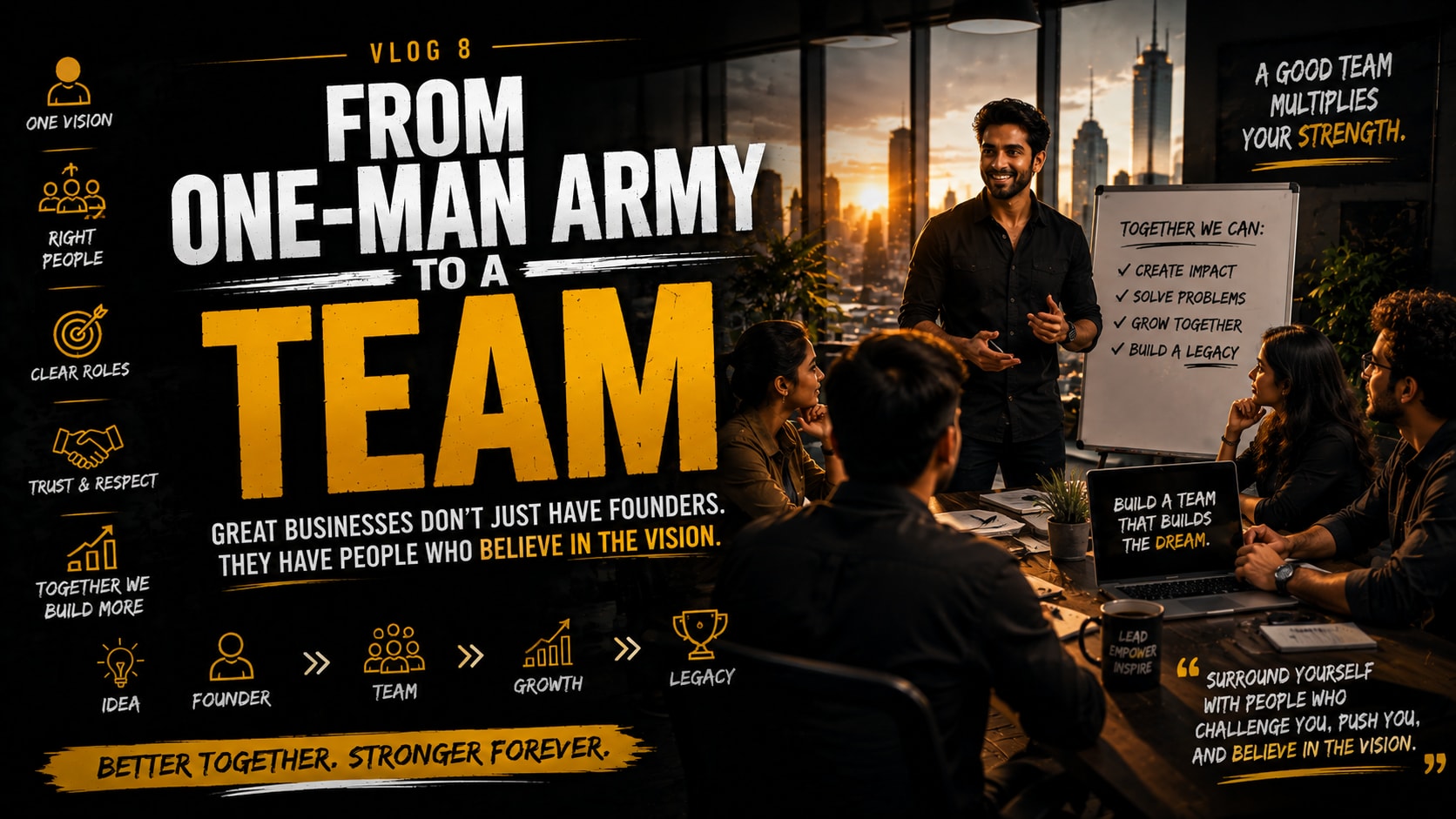
There is a stage in every entrepreneur's journey when everything belongs to you.
The idea is yours.
The risk is yours.
The investment is yours.
The marketing is yours.
The sales are yours.
The customer calls come to you.
The problems come to you. And when something goes wrong, there is nobody else to blame.
You become the founder, the salesperson, the marketer, the accountant, the customer support executive, the technician, the delivery person and sometimes even the person making the coffee.
In the beginning, this is not a weakness.
It is necessary.
When you are starting with limited money, limited resources and a lot to learn, becoming a one-man army can teach you things that no management course ever could. You learn how the business actually works.
You speak directly to customers.
You understand their complaints.
You discover how difficult it is to make a sale.
You understand where money goes.
You learn what takes five minutes and what secretly takes five hours.
You make mistakes because you are doing everything yourself.
And those mistakes become your education. But eventually, something changes. The business begins to grow.
And suddenly, the same thing that once made you strong begins to become your biggest limitation.
You cannot do everything yourself anymore.
You are answering emails when you should be meeting clients.
You are designing when you should be planning.
You are solving small operational problems when you should be thinking about the future.
You are doing work that someone else could do while the decisions that only you can make are waiting for you. And this is one of the hardest lessons for a founder to accept:
Growth requires you to stop being the only person who can make things happen.
At first, doing everything yourself feels powerful.
You know everything. You control everything. Nobody can do it exactly the way you do. Nobody understands the business like you. Nobody cares about it as much as you. And perhaps that is true. But if everything depends on you, then you haven't really built a business.
You have built a job that happens to have your name on it.
A business begins to become something bigger when it can move forward even when you are not personally touching every part of it.
That requires people.
But hiring people is not simply about finding someone who can do a task.
It is about finding people who can carry a part of your vision. And that is a much bigger responsibility.
Because when you bring someone into your business, you aren't just giving them work.
You are giving them a piece of something you built.
You are trusting them with your customers.
Your reputation.
Your money.
Your time.
Your future.
And that is why building a team is one of the most difficult transitions in entrepreneurship. You have to learn something that many founders struggle with:
You have to trust other people. And trust is difficult when you built everything yourself. You know exactly how you would do something. But your employee may do it differently. And different doesn't always mean wrong. This is where leadership begins.
You have to stop asking: “Can they do it exactly like me?”
And start asking: “Can they do it well enough to create the result we need?”
Because if you insist that everyone work exactly like you, you are not building a team. You are building copies of yourself. And your business doesn't need copies of you. It needs people who bring abilities that you don't have.
Maybe you are good at vision but terrible at finance.
Maybe you are good at creativity but struggle with operations.
Maybe you can sell but don't understand technology.
Maybe you can build products but don't know how to manage people. That's okay.
You don't have to be good at everything.
You need to understand yourself well enough to recognize what is missing. This is why knowing yourself, something we discussed in the beginning of this journey, becomes important again.
Your weaknesses don't make you a bad entrepreneur. Ignoring them does.
If you are not good with numbers, find someone who is.
If you are not good at marketing, bring someone who understands it.
If you cannot manage operations, build a system or bring someone who can.
If you are not good at technology, find the person who is. Your strength as a founder isn't that you can do everything. Your strength is knowing what needs to be done and who can do it. That is leadership.
But there is a dangerous mistake founders make when they begin hiring.
They hire people because they need help.
They don't think about what the business actually needs. So they add people without structure.
One person does five unrelated things. Another person doesn't know who they report to.
Nobody knows who is responsible for what. Everyone is busy. But nothing is organized.
And suddenly, the team that was supposed to make the business easier makes everything more complicated.
That is why building a team requires structure. You don't simply need more people. You need the right people in the right places.
A growing business may slowly need different functions.
Someone focused on marketing.
Someone managing customer relationships.
Someone handling finances.
Someone managing operations.
Someone working in the field.
Someone handling technology.
Someone managing production. And eventually, people managing the people.
You don't need all of these on day one. Remember the philosophy of starting small. Build the department when the business needs the department. Hire the person when the work justifies the role. Grow because the business requires it—not because having a large team looks impressive. Because every employee is not simply a salary. It is a responsibility.
You have to create work for them.
You have to train them.
You have to guide them.
You have to pay them.
You have to give them clarity. And you have to create an environment where they can actually succeed.
This is where entrepreneurship becomes more human.
When you were working alone, your mistakes affected you.
When you have a team, your decisions affect other people's lives. Your business may become someone's salary.
Someone's rent.
Someone's family's education.
Someone's future. That should make you more responsible—not more afraid. Because leadership isn't about having people work for you. It is about creating a place where people can grow with you. And this is where many founders misunderstand leadership.
They think being the boss means giving orders. It doesn't. Anyone can give orders. Leadership means taking responsibility. When your team succeeds, give them credit. When your team fails, look at your own systems.
Did you communicate properly?
Did you train them?
Did you give them enough resources?
Did you set the right expectations?
Did you hire the right person?
Did you create a process?
A leader doesn't simply ask: “Who made the mistake?”
A leader also asks: “Why did our system allow this mistake to happen?”
That question creates better businesses.
And then comes one of the most difficult things for a founder: letting go.
You have to let other people make decisions.
You have to allow them to make mistakes.
You have to let them learn.
You have to stop checking every tiny detail. Because if every decision still needs your approval, you haven't delegated. You've simply created assistants.
Delegation is not giving someone a task.
Delegation is giving someone ownership of an outcome. There is a difference.
You can tell someone: “Send this email.” Or you can say: “Take responsibility for our customer communication.” The second one creates ownership. And ownership creates leaders.
This is how a company grows beyond the founder. One person takes responsibility. Then another. Then another. Eventually, you have people who don't wait for you to tell them what to do. They understand what needs to happen.
They solve problems.
They make decisions.
They protect the company.
They think about customers.
They think about the future.
And suddenly, you realize something beautiful: You are no longer carrying the entire business. The business is carrying itself. That is growth. But building a team doesn't mean finding people who agree with everything you say.
In fact, you should want people who challenge you. If everyone in the room agrees with you, you may feel like the smartest person in the room. But you may also be the person making the biggest mistake in the room.
A strong team should be able to say:
“I don't think this will work.”
“Have we considered this?”
“The customer is telling us something different.”
“The numbers don't support this decision.”
“This process isn't efficient.”
You may not always agree with them. But you should be willing to listen. Because the goal isn't to prove that the founder is right. The goal is to make the business right. That requires humility. And humility becomes increasingly important as your company grows. Because the bigger your title becomes, the easier it is to stop hearing uncomfortable truths. People become careful around you. They don't want to disappoint you. They tell you what they think you want to hear. And if you aren't careful, you can build a company where everyone agrees with the founder while the market disagrees with the company. Never let that happen.
Create a culture where truth is more valuable than ego.
Where problems can be discussed.
Where mistakes can be admitted.
Where good ideas can come from anyone.
Where people are respected for what they contribute, not simply for their position. Because eventually, culture becomes one of the strongest invisible forces inside a business.
You may create the first culture. But as the team grows, the culture becomes something everyone creates. And that is why who you hire matters. Skills can be taught. Experience can be developed. But attitude, integrity, responsibility and willingness to learn are much harder to manufacture.
You can train someone to use a system.
You cannot easily train someone to care. So when you build your team, don't only ask: “Can this person do the job?”
Ask: “Can I trust this person with the responsibility?” Because one wrong person in the wrong position can damage more than their own work.
They can affect customers.
They can affect other employees.
They can affect morale.
They can affect reputation.
They can affect the culture.
That doesn't mean you should fear hiring.
It means you should take hiring seriously.
And remember something else: You are also being interviewed. Every time someone joins your company, they are deciding whether they believe in you.
They are asking themselves:
Is this company going somewhere?
Will I learn here?
Will I be respected?
Will my work matter?
Will the founder keep their promises?
Will I have a future here?
The best people don't only choose companies.
They choose leaders. So become the kind of leader good people want to follow.
Not through fear.
Through vision.
Through fairness.
Through consistency.
Through example.
If you expect discipline, be disciplined.
If you expect honesty, be honest.
If you expect people to take responsibility, take responsibility yourself.
Your team will watch what you do far more carefully than what you say. And perhaps this is one of the deepest truths of leadership: People don't follow your words. They follow your example. In the beginning, you may have to push the business forward.
Later, your job becomes creating an environment where the business can move forward without you pushing every second. That is a completely different role. You move from worker to builder.
From builder to leader.
From leader to mentor. And eventually, perhaps, from being the person who does everything to being the person who creates people capable of doing great things.
That is when your company starts becoming bigger than you. And that is exactly what you should want. Because if your business cannot survive without you, then your business owns you. But if your business can continue without you, then you have built something.
Something with systems.
Something with people.
Something with culture.
Something with direction.
Something with a future. That is the beginning of a real company. And perhaps one day, you will sit quietly and watch your team solve a problem without calling you.
You will see someone make a decision you would have made.
You will see a customer being taken care of without your involvement.
You will see a project completed without your supervision. And for a moment, you may feel unnecessary. But don't. That moment is success.
Because your goal was never to make yourself indispensable. Your goal was to make the business strong. You started as one person carrying an idea. Then you became one person carrying a business. Then you found people who could carry pieces of it with you. And eventually, you built something where many people are carrying the same vision together. That is how an idea becomes an organization. And that is how a founder becomes a leader.
So start alone if you have to. Learn everything you can. Become your own salesperson. Become your own marketer. Become your own problem solver. Understand every corner of your business. But don't stay there forever.
Because a one-man army can start a business. A team builds a company. And a great team doesn't simply make your business bigger.
It makes your vision bigger than what you could have achieved alone. Maybe you started with one dream. But when you find the right people, that dream stops belonging only to you. It becomes something you build together.
Something you grow together.
Something you protect together.
Something you leave behind together. And that is where entrepreneurship begins to transform into leadership. Not when people start working for you. But when people start believing in what you are building. Closing Thought
“You may start the journey alone, but if you want to build something that outlives you, you must eventually give others a reason to walk beside you.” K.S.Lakhotia