

There is something every entrepreneur wants when they begin a business. Success.
They imagine the customers coming in, the numbers growing, the team getting bigger, the business becoming known, and one day looking back and saying, “I made it.”
But nobody starts a business imagining the other side of the story.
The customer who says no.
The investment that doesn't return.
The product that doesn't sell.
The employee who leaves.
The partnership that falls apart.
The month when the numbers don't make sense.
The decision you regret.
The night when you sit alone and wonder whether you made a mistake by starting at all. Nobody dreams about these moments. But almost every entrepreneur eventually meets them. And when that day comes, you have a choice.
You can look at failure as proof that you were never meant to build a business. Or you can look at it as something else.
A lesson that your business was trying to teach you. Because failure is not always the opposite of success. Sometimes, failure is part of the blueprint.
When you begin, you have a picture in your mind of how everything should work.
You think you understand your customer.
You think you understand the market.
You think you know what people want.
You think your strategy is strong.
You think your numbers will work. And then you launch. And reality gives you a completely different answer. At first, that answer can hurt. Because you didn't just invest money. You invested your time, Your energy, Your confidence, Sometimes even your identity, You told people about your idea, You believed in it, You worked on it when nobody else cared.
So when it fails, it can feel like you failed. But your business is not you. An idea can fail without the person behind it being a failure.
A product can fail, A strategy can fail, A campaign can fail, A company can fail. But none of those things have the power to define the person who is willing to learn from them. That distinction is incredibly important. Because if you make every failure personal, you become afraid to experiment. And if you become afraid to experiment, you stop discovering. And when you stop discovering, you stop growing.
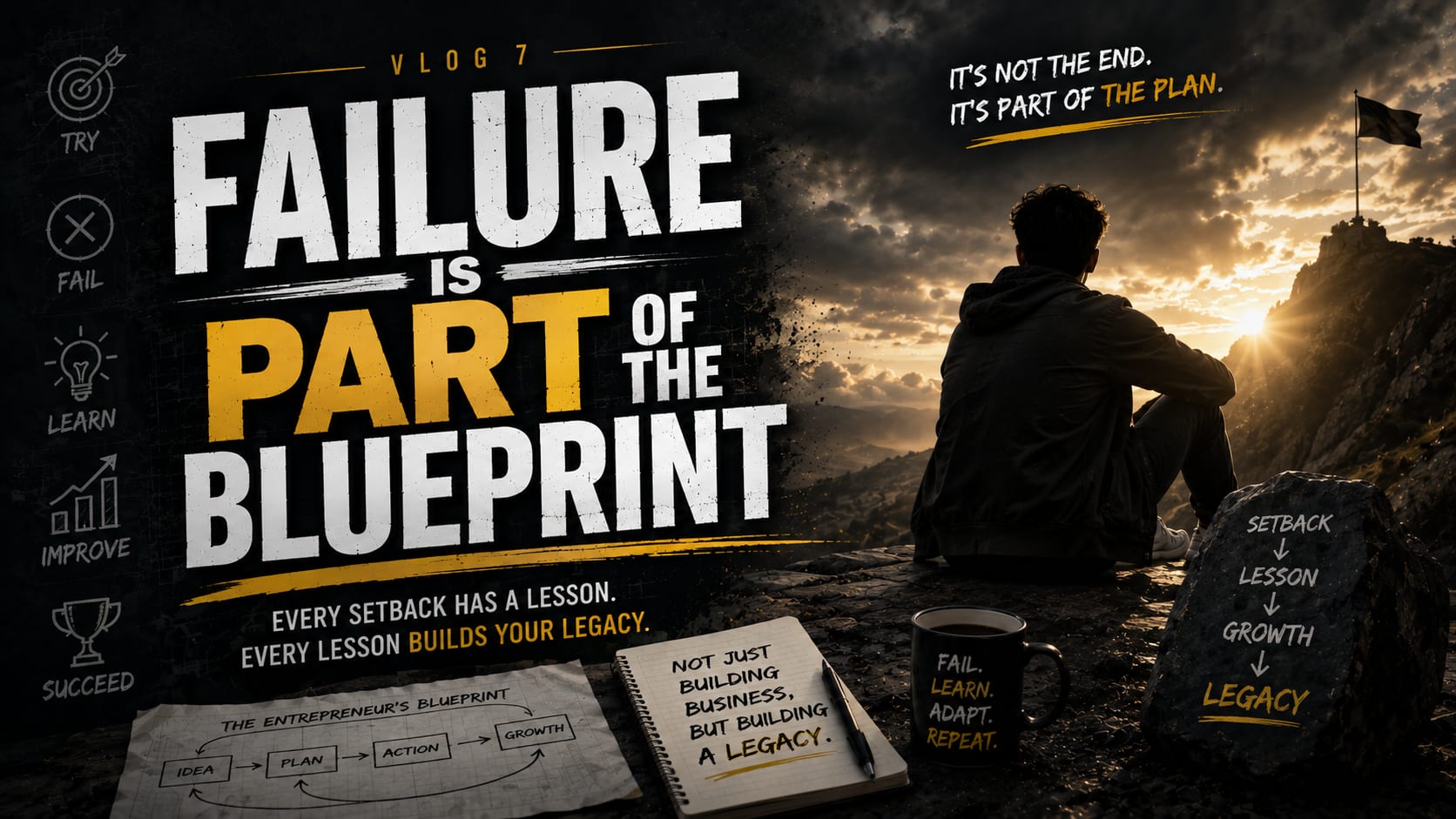
Entrepreneurship requires experimentation. You try something. You observe what happens. You learn > You change > You try again = That is not failure That is the process.
Imagine an entrepreneur launching a product and nobody buys it. The first reaction might be: “The market doesn't want this.”
But that conclusion may be too simple.
Maybe the market doesn't understand it.
Maybe the marketing was poor.
Maybe the pricing was wrong.
Maybe the product was launched to the wrong audience.
Maybe the timing was wrong.
Maybe the product solves a problem that isn't painful enough.
Maybe the competition is stronger.
Maybe the product itself needs to change. One result can have many explanations. And that is why entrepreneurs need something more valuable than motivation.
They need curiosity. Instead of asking: “Why did I fail?” Ask: “What exactly happened?” Then ask: “Why did it happen?”
Then: “What can I change?” That is how failure becomes data. And data can become strategy. A mistake becomes expensive only when you pay for it and learn nothing. If you lose ₹10,000 and learn something that prevents you from losing ₹1 lakh later, that ₹10,000 was not simply a loss.
It was education. Expensive education, perhaps. Painful education, definitely. But education.
This doesn't mean you should intentionally chase failure. Failure isn't something to celebrate simply because it sounds motivational.
Real losses hurt.
Real businesses can collapse.
People can lose their savings.
Employees can lose their jobs.
Families can be affected.
So don't romanticize failure.
Respect it.
Learn from it.
Prepare for it. And most importantly, don't let one failure become an excuse to stop thinking.
Because sometimes the smartest thing an entrepreneur can do after failing is not to try harder.
It is to stop.
Look.
Think.
And understand.
There are moments when persistence is courage. And there are moments when persistence is simply refusing to accept reality.
Knowing the difference is part of becoming an entrepreneur. If something isn't working, don't keep throwing money at it just because you have already invested money.
The money you spent yesterday cannot be recovered by making a bad decision today.
Sometimes you have to accept: “This isn't working.”
And then ask: “What can I take from it?”
Maybe you change the product.
Maybe you change the customer.
Maybe you change the business model.
Maybe you change the price.
Maybe you change the team.
Maybe you change the strategy.
Maybe you close one door completely so you can open another. There is no shame in changing direction.
A ship can change its course without admitting that the journey was a mistake.
It simply understands that the destination requires a different route. Your business can do the same.
One of the greatest dangers in entrepreneurship is ego.
You become attached to your idea.
You defend it.
You explain why the customer is wrong.
You blame the market.
You blame the economy.
You blame competitors.
You blame employees.
You blame timing. And perhaps sometimes those things genuinely contributed. But an entrepreneur must always ask one uncomfortable
question: “What was my part in this?” That question is difficult. But it is powerful. Because the moment you take responsibility, you regain control.
You cannot control everything that happens to your business. But you can control how you respond to it. And that is where growth begins.
Failure also teaches you something success often cannot: humility.
When everything is going well, it is easy to believe you are brilliant.
Customers are coming.
Money is coming.
People are praising you.
Your confidence is high.
You start believing that every decision you make is correct. Then something goes wrong.
And suddenly, reality reminds you that you are still learning.
That lesson can be uncomfortable.
But it can also protect you.
Because an entrepreneur who knows they don't know everything remains teachable. And a teachable entrepreneur can survive for a very long time.
There will be times when someone younger than you teaches you something.
Someone with less experience will have a better idea. A customer will identify a problem you completely missed. An employee will suggest a solution you never considered. Don't let your ego prevent you from learning.
The person who can say “I was wrong” has an advantage over the person who must always prove that they were right. And then there is another kind of failure.
The quiet kind.
The kind where nothing dramatic happens.
You simply stop improving.
You become comfortable.
The business is making enough money.
The customers are coming.
Everything seems fine. But the world is changing around you.
New technology appears.
New competitors arrive.
Customer expectations change.
And suddenly, what worked five years ago no longer works today.
This is why an entrepreneur must never stop learning. Success can become dangerous when it convinces you that you have already figured everything out.
The market doesn't care about what worked yesterday. It rewards what creates value today. And that means you have to keep evolving.
Keep questioning.
Keep observing.
Keep learning.
Because sometimes the biggest threat to a successful business isn't failure.
It is complacency.
Failure can wake you up.
Success can make you comfortable. And comfort, if you aren't careful, can quietly become stagnation.
That is why every entrepreneur needs to develop resilience. Resilience doesn't mean pretending that everything is fine. It means accepting that sometimes things won't be fine—and still finding a way forward.
You may have a terrible month.
You may lose a major client.
You may have to cut expenses.
You may have to start again.
You may have to go back to doing things yourself.
You may have to admit that a decision was wrong. But none of that means the journey is over. It means the journey has changed. And sometimes the second version of your business is stronger because the first version taught you what the second one needed.
Think about that. Your failure may contain the instructions for your next success.
The problem is that we usually read failure emotionally instead of intellectually.
We say: “I lost.” Instead, ask: “What did I learn?”
We say: “Nobody wants my product.”
Ask: “What did the customers tell me?”
We say: “The business failed.”
Ask: “What part of the business model failed?” That small change in language creates a completely different mindset.
You stop seeing yourself as the problem.
You start studying the problem.
And when you study a problem long enough, you can often find a solution.
This is why the strongest entrepreneurs aren't necessarily the people who never fail. They are often the people who extract the most learning from every failure. One person can lose ₹1 lakh and walk away with nothing except regret. Another can lose ₹1 lakh and walk away with knowledge worth millions.
The event was the same. The outcome was different because the interpretation was different. And this is where entrepreneurship becomes almost philosophical.
The world will give you events. You decide what those events mean. A rejection can mean: “I'm not good enough.”
Or it can mean:
“I need to improve my offer.” A failed business can mean: “I should never try again.”
Or:
“Now I know what not to do.” A difficult year can mean: “Everything is against me.”
Or:
“This is the year that taught me how to survive.” The event is real. But the meaning you give it determines what you do next. And sometimes, the greatest business lessons come from moments you desperately wanted to forget.
Years later, you may look back at the difficult period and realize:
That rejection made you better at sales.
That failed product made you understand customers.
That financial mistake made you disciplined.
That difficult employee taught you leadership.
That failed partnership taught you how to choose people.
That bad decision taught you to slow down.
That difficult year taught you resilience. And suddenly, what once looked like a detour becomes part of the road.
That's why you should never judge your journey too early. You may be living through a chapter that makes no sense right now.
But you don't know what that chapter is preparing you for. Your job is to keep learning. Keep building. Keep adapting. And when necessary, begin again.
Because beginning again is not going back to zero. You are not the same person who started the first time.
You carry experience.
You carry knowledge.
You carry scars.
You carry mistakes.
You carry lessons.
You carry a better understanding of yourself. So if you have failed before, don't automatically call yourself unsuccessful.
Ask yourself what you know now that you didn't know then. That knowledge is your new capital.
Sometimes you don't need more money to start again.
Sometimes you need a better strategy.
Sometimes you need more discipline.
Sometimes you need a different team.
Sometimes you simply need the courage to try again with everything you learned. And perhaps this is why the entrepreneurial journey is so different from the life most people imagine.
You don't build a successful business by avoiding every mistake. You build it by becoming better at handling mistakes.
You don't eliminate uncertainty. You become better at making decisions inside uncertainty. You don't eliminate risk. You learn how to manage risk. You don't eliminate failure. You become harder to destroy when failure arrives. That is strength. Not the strength of someone who has never fallen.
The strength of someone who knows how to stand back up. So when your business fails at something, don't rush to bury the lesson with the failure. Look at it - Study it - Understand it - Write it down - Remember it. And carry it into the next chapter. Because your business plan should not only contain your dreams.
It should also contain the lessons your failures have taught you. That is why failure belongs in the blueprint. Not because failure is the goal. But because learning is. You are going to make mistakes. You are going to make decisions that you later wish you had made differently. You are going to meet people who disappoint you. You are going to have ideas that don't work. You are going to experience days when quitting feels easier than continuing.
And when those days come, remember why you started. Not just for money, Not just for status. Not just to prove something to someone. But because there was something you wanted to build. Something you believed could exist. Something that didn't exist before you decided to create it.
That vision deserves more than one bad chapter. So take the lesson. Leave the regret. Adjust the strategy. And continue.
Because sometimes the road to success isn't a straight line. Sometimes it looks like: Start > Fail > Learn > Change > Start again > Fail better > Learn deeper > Build stronger. And one day, when you finally reach the place you were trying to reach, you may look back and realize something unexpected.
The failures you once wanted to forget were actually some of the most important parts of your story. They didn't destroy the dream. They shaped it. They didn't make you weaker. They taught you where your strength needed to grow. And they didn't necessarily take you away from success. Sometimes, they were quietly preparing you for it.
So don't be afraid of failure. Be afraid of failing without learning. Because failure itself may only be a moment.
But the lesson can stay with you for the rest of your life. And perhaps that is the real blueprint of entrepreneurship: You build - You test - You fall - You learn - You rebuild. And every time you rise, you build a little stronger than before.
“Failure is not the chapter that ends your story; it is often the chapter that teaches you how to write the next one better". K.S.Lakhotia